
Stress support is one of the most crowded categories in modern supplementation. Search for calm,
focus, or resilience support, and the market offers an endless stream of capsules, powders, gummies,
and quick-fix blends promising better balance in a matter of days.
Yet for many people, the experience is familiar: an initial lift, a mild calming effect, or sometimes no
meaningful difference at all. A week later, the product is forgotten in a cupboard, replaced by another
trend, another formula, or another promise.
The problem is not always the ingredient. More often, the problem is the way stress support has been designed.
Stress Support Is Often Built Too Simply
Many stress supplements are built around a single popular ingredient and a familiar promise. One herb
becomes the headline. One trend becomes the formula. One mechanism is expected to solve a much
broader issue. But stress does not affect the body in one simple way.
It influences mental clarity, sleep quality, nervous system load, energy rhythm, emotional resilience,
and the ability to recover from daily pressure. Supporting only one part of that system often leads to
inconsistent results.
This is one of the main reasons many stress support products feel promising in theory, but are inconsistent
in daily use.
Why Single-Ingredient Thinking Often Falls Short
A strong ingredient can be useful. But stress rarely behaves like a single-pathway problem. When support is built around one fashionable ingredient alone, the result is often too narrow.
It may help one part of the picture, while leaving the rest unsupported. That is where many formulas begin to lose consistency. A product may feel calming, but leave energy flat. A product may support focus, but do little for nervousness
tension.
A product may improve mood briefly, but not support steadier daily resilience.
This is not always a quality issue. It is often a structural issue.
Consistency Matters More Than Intensity
One of the biggest misunderstandings in stress support is the belief that stronger always means better. In reality, what most people need is not intensity. They need consistency.
The most useful support is rarely the one that feels dramatic on day one. It is the one that integrates
smoothly into daily life, supports steadier mental clarity, and helps the body respond more consistently
over time.
That is where many fast-positioned products fail. They are designed to feel noticeable. Not necessarily to feel sustainable.
Structured Formulation Changes the Outcome
This is where formulation matters more than trend. A better stress support formula is not simply built around a single ingredient. It is structured to support. The wider stress response is more intelligible.
That means thinking beyond one active and looking at how ingredients work together across functions, balance, and daily tolerance.
This is where a more structured botanical approach becomes more useful. Instead of relying on one ingredient to do everything, the formula is designed to support calm, focus, resilience, and steadier daily function as a system.
That shift sounds subtle. In practice, it changes everything.
Why BotanicaLab® Takes a Different Approach
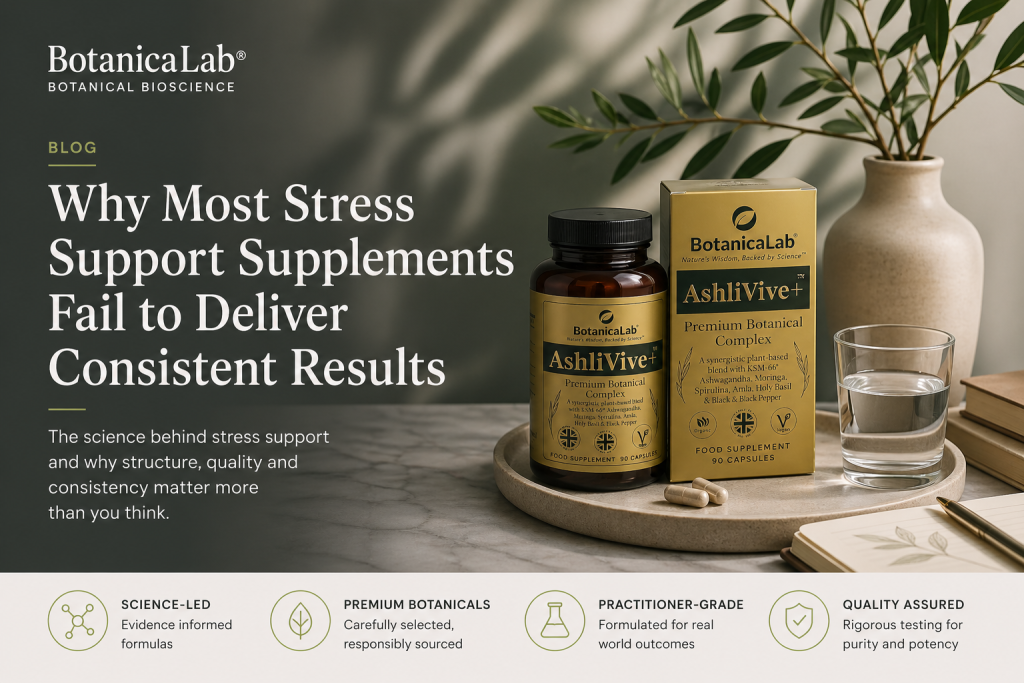
At BotanicaLab®, we believe effective stress support should feel measured, steady, and sustainable. That means moving away from trend-led formulation and toward a more structured model of botanical
support — one designed for daily consistency, not short-term novelty.
AshliVive+® was developed with that principle in mind. Rather than relying on a single-ingredient story, it was built as a practitioner-grade botanical support
formula centred around KSM-66® Ashwagandha and supported by a more structured botanical A
framework designed for calm focus, steadier energy, and daily resilience.
2
Not louder.
Just better structured.
The Better Question to Ask
When evaluating stress support, the most useful question is often not:
“Does this contain the right ingredient?”
It is:
“Has this been structured well enough to support consistent results?”
That is usually where the difference lies. And over time, consistency is what people trust most.